Category

News

BHI’s Top 10 BioHealth Capital Region Stories of 2025

By News

The BioHealth Capital Region closed out 2025 with clear evidence of strength and momentum. While life sciences companies across the country navigated capital constraints, policy uncertainty, and global market shifts, the BHCR region continued to grow. Major manufacturers expanded their U.S. footprints, new facilities came online, research institutions deepened their role in advanced technologies, and investment flowed across companies at every stage. Taken together, these stories show a region that did more than hold its ground. It advanced, adapted, and continued to lead.

The BioHealth Capital Region Maintains a Top 3 National Ranking
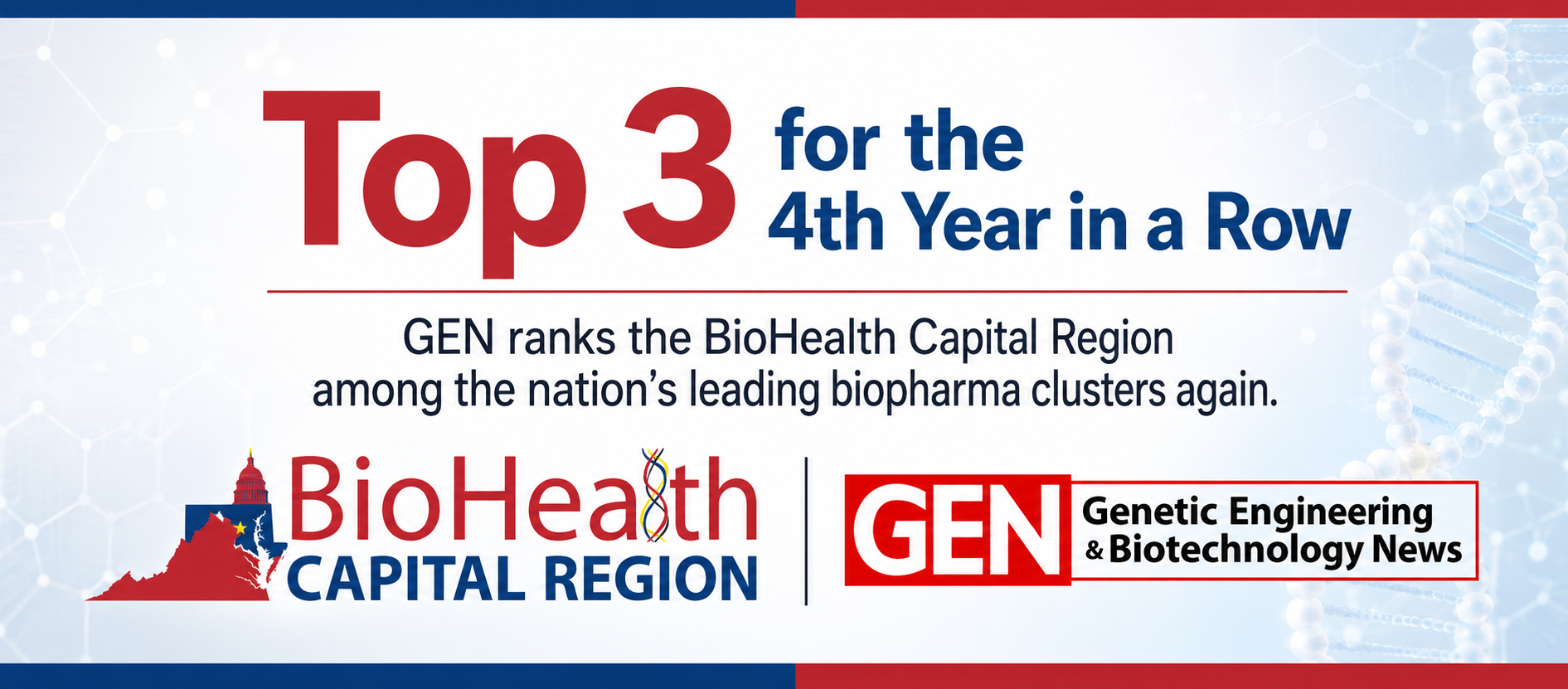
For the third consecutive year, the BioHealth Capital Region earned a Top 3 position in GEN’s U.S. Biopharma Cluster Rankings. The region led the nation in biotechnology-related patents and ranked third in both NIH funding and lab space, maintaining strong performance despite economic pressure across the sector. Continued infrastructure investment and new facilities across Maryland and Virginia underscore long-term stability and competitiveness.
https://biohealthinnovation.org/the-biohealth-capital-region-maintains-top-3-spot-in-gens-2025-u-s-biopharma-cluster-rankings/

Lilly Commits $5 Billion to New Manufacturing in Virginia
Eli Lilly announced plans to build a $5 billion manufacturing facility in Goochland County, Virginia, marking its first fully integrated U.S. site dedicated to the manufacture of active pharmaceutical ingredients and drug products for bioconjugates and monoclonal antibodies. The project will create more than 650 permanent jobs and support advanced manufacturing using AI, automation, and digital systems.
https://biohealthinnovation.org/lilly-announces-plans-to-build-5-billion-manufacturing-facility-in-virginia/

AstraZeneca Expands Virginia Investment to $4.5 Billion
AstraZeneca increased its planned investment in a new Albemarle County manufacturing facility to $4.5 billion, expanding the site’s scope to include antibody drug conjugates alongside metabolic and oncology products. The project is expected to create approximately 3,600 direct and indirect jobs and will anchor a broader $50 billion U.S. manufacturing and R&D commitment.
https://biohealthinnovation.org/astrazeneca-plans-to-increase-investment-and-scope-of-its-virginia-manufacturing-facility-to-4-5-billion-creating-3600-new-jobs/

Nearly $3 Billion Invested in Montgomery County Companies
Montgomery County companies attracted $2.9 billion in investment during 2024 across mergers, acquisitions, venture capital, and private funding. Life sciences accounted for more than half a billion dollars, reinforcing the county’s role as a regional anchor for biohealth innovation. Over 100 deals reflected strength across companies of all sizes.
https://biohealthinnovation.org/mcedc-nearly-3-billion-invested-in-montgomery-county-maryland-companies-in-2024/

Merck Breaks Ground on $3 Billion Manufacturing Center in Virginia
Merck began construction on a $3 billion pharmaceutical manufacturing Center of Excellence in Elkton, Virginia. The project will expand small molecule manufacturing and testing capabilities while supporting more than 500 permanent roles and thousands of construction jobs. The investment builds on Merck’s long-standing presence in the region and its broader U.S. manufacturing strategy.
https://biohealthinnovation.org/merck-breaks-ground-on-3-billion-center-of-excellence-for-pharmaceutical-manufacturing-in-elkton-virginia/

AstraZeneca Opens $300 Million Rockville Manufacturing Hub
AstraZeneca unveiled its new $300 million Rockville Manufacturing Center, focused on cell and gene therapies for oncology clinical trials. Built using advanced digital tools, the facility reflects continued confidence in Montgomery County at a time of broader federal funding uncertainty. The site is expected to begin delivering therapies to patients in the near term.
https://biohealthinnovation.org/wbj-astrazeneca-unveils-300m-rockville-investment-a-boost-for-moco-amid-federal-cuts/

Samsung Biologics Establishes U.S. Manufacturing Footprint
Samsung Biologics announced the acquisition of the former Human Genome Sciences facility in Rockville, Maryland, securing its first U.S.-based manufacturing site. The transaction adds 60,000 liters of biologics capacity to Samsung’s global network, retains more than 500 skilled jobs, and strengthens domestic supply chain resilience.
https://biohealthinnovation.org/samsung-biologics-expands-u-s-manufacturing-capabilities-with-strategic-acquisition-of-human-genome-sciences-from-gsk/

USP Opens Advanced Technologies Laboratory in Maryland
The U.S. Pharmacopeia launched a new Advanced Technologies Laboratory in Rockville to support the adoption of advanced manufacturing, real-time quality monitoring, and alternative API production methods. The lab is designed to accelerate scalable solutions that strengthen medicine supply chains and support domestic manufacturing efforts.
https://biohealthinnovation.org/usp-announces-new-advanced-technologies-laboratory-in-maryland-to-accelerate-and-scale-pharmaceutical-manufacturing-innovations/

Northern Virginia Launches Its First Innovation District
With support from GO Virginia, Northern Virginia launched its first Innovation District focused on life sciences, aerospace, defense, and semiconductor industries. Led by George Mason University in partnership with Prince William County and the City of Manassas, the district aims to accelerate research translation, company formation, and workforce development.
https://biohealthinnovation.org/george-mason-is-part-of-northern-virginias-first-innovation-district-launched-with-transformational-grant-from-go-virginia/

Where Human and Artificial Intelligence Converge
The 2025 BioHealth Capital Region Forum brought together more than 750 attendees for two days of programming focused on AI, quantum technologies, advanced manufacturing, and investment. The week highlighted the region’s leadership across research, commercialization, and capital formation, while reinforcing its position as a Top 3 U.S. biopharma cluster.
https://biohealthinnovation.org/where-human-and-artificial-intelligence-converge-a-recap-of-the-2025-biohealth-capital-region-forum/

Looking ahead to 2026, the BioHealth Capital Region enters this year with depth across research, manufacturing, talent, and capital. Projects announced over 2025 are moving into execution, partnerships are strengthening, and the region’s role in national health security and innovation continues to expand. The trajectory is clear, and the foundation is strong. What comes next will build on a year that demonstrated both toughness and ambition.

From Can to Should: Reassessing Viability in 2026

By EIR Insights, News

Last year, I wrote a LinkedIn Article titled To be or not to be: Just because you CAN, doesn’t mean you SHOULD.” The point was straightforward. Passion and good science are not enough. They never really were. That post was a reaction to what I was seeing across early-stage biotech and MedTech at the time. The environment has not eased since then. If anything, the bar has moved higher.

The requirements for viability are more stringent today than they were even a year ago. Early-stage capital remains difficult to access, particularly at the seed and Series A stages, unless a company has human proof of concept. Angel investors want de-risking. Most venture funds will not underwrite the earliest technical risk. Government funding used to fill that gap. The uncertainty around the reauthorization of innovation investment programs has made it harder to hit commercially meaningful milestones at exactly the stage when companies need that support most. Until policy catches up, founders are forced to seek private capital that is increasingly selective and unforgiving.

This shifts the question founders need to ask themselves. It is no longer whether an idea is interesting or even whether it addresses an unmet need. The question is whether the idea can survive the current validation threshold. That threshold is no longer defined by enthusiasm or momentum. It is defined by evidence, timing, and a clear path to value creation that stands up to scrutiny.

Commercial realism remains the most common failure point. Founders and CEOs are almost always optimistic about their opportunity, and they should be. If the CEO is not the champion, no one else will be. The problem arises when optimism replaces rigor. Market size is often overstated. Competitive dynamics are underestimated. Pricing and reimbursement assumptions are built on hope rather than data. Real market assessments require primary customer discovery paired with precedent sales data, both top-down and bottom-up. They also require discipline about who the customer is and where adoption will realistically occur.

Differentiation has also changed. Incremental improvements used to matter. Slight changes in dosing or convenience could be enough in some cases, but that still holds only if the market signals that it values those changes. In many therapeutic and digital health categories, that bar has risen. The existence of a standard of care, even an imperfect one, changes everything. Workarounds that are cheaper and good enough are formidable competitors. A fourth- or fifth-line product rarely succeeds just because the total addressable market is significant. Investors are not persuaded by big numbers without a sophisticated explanation of what portion of that market is reachable and why.

Health economics can no longer be an afterthought. Payers are not focused on novelty. They are focused on sustainability. Cost effectiveness, total cost of care, and system-level impact matter early, not late. Clinical development strategies that ignore this reality tend to produce assets that struggle to gain traction even if they reach approval.

Manufacturing and supply chain considerations are now decisive factors in viability. Fully burdened cost modeling should be mandatory, not optional. Many promising concepts fail when exposed to the realities of sourcing, scale-up, tech transfer, and CDMO capacity. Lead times for specialized reagents, limited suppliers, geopolitical pressures, and competition from larger customers all introduce risks that can derail timelines and margins. Profitability estimates that are not grounded in real quotes and realistic assumptions are unreliable. A product that cannot be manufactured profitably at scale is not a product. It is an experiment.

Intellectual property expectations have also hardened. Venture investors continue to favor novel chemical entities with enforceable composition-of-matter claims. Method-of-use claims and simple repurposing strategies remain difficult to defend commercially. Off-label use, generic substitution, and payer resistance erode value quickly. Repurposing can be both capital and clinically efficient, but unless there is a credible way to lock the market through delivery technology, owned chemistry, or a pricing model that holds, it is rarely attractive to institutional capital. The irony is that some of the most efficient paths to patient benefit struggle the most under current investment models.

Clinical adoption risk extends far beyond efficacy. I look at alternatives already in use and ask who they fail and why. I look at early predictors of response and whether patient selection is feasible. I look at whose pain point is being addressed and whether that aligns across providers, patients, payers, and regulators. Evidence requirements vary by stakeholder, and the costs and time required to satisfy them must be modeled honestly. I also look closely at who makes the buying decision and how the product would be sold. Adoption fails as often for psychological and behavioral reasons as it does for scientific ones.

Deciding whether to move forward, pause, or walk away requires discipline. Founders need to evaluate unmet need, solution fit, market opportunity, IP defensibility, validation requirements, development and manufacturing plans, regulatory and reimbursement pathways, financial models, and exit logic together. Weaknesses in any one area can undermine the entire effort. The willingness to stop is not a sign of failure. It is a sign of judgment. In this environment, the threshold for validation is higher across the board, even in areas that remain attractive to pharma and investors.

This is where an experienced, external perspective matters. A short, focused conversation can surface gaps that would otherwise take years and significant capital to discover. Stress-testing assumptions early saves time, money, and energy. Not every idea should become a company. Not every asset belongs in a pipeline. The goal is not to build something at all costs. The goal is to build something that has a real chance of reaching patients and creating value along the way.

Being in the business of innovation means living with uncertainty and learning constantly. It also means making hard calls sooner rather than later. Just because you can still does not mean you should. The difference between the two has never mattered more.

BHI EIR Insights: 7 Tactics to Optimize Launch Messaging – Part III

By News

by Jonathan Kay, MPP, Managing Partner, Health Market Experts & BioHealth Innovation, Inc. Entrepreneur-in-Residence

In our last two posts of this series, we discussed:

  • Tactic #1: Test, Don’t Guess (i.e., adopt a data-driven mindset)
  • Tactic #2: Know Your Stakeholders (i.e., avoid a one-size-fits-all approach)

Insight 3: Listen First

Once you have determined who to speak to, it’s time to focus on how to speak to them.

Recall, we talked about the need to be precise and purposeful:

  • Who is the message for?
  • What information do they need?
  • Will the message fulfill its purpose?
  • Will the message influence opinions and motivate behavior?

To answer those questions, we listen.

Listening to your target audience can take many forms:

  • Customer feedback (e.g., customer satisfaction, CRM, or the sales team) 🔁
  • Online (e.g., social media and, increasingly, seeing what AI “says”)  📊
  • Customer discovery / research (e.g., stakeholder interviews and surveys) 📝

Listening produces the raw material for developing messages that we test before launch.

During a commercial strategy and segmentation engagement for implantable cardiac devices, we listened to C-level leaders in marketing and sales and field representatives; we searched online; and we conducted original interviews and surveys with a wide range of target audiences to anticipate their response.

All audiences needed to hear about safety, efficacy, and value. However, when we tested messages, the cardiac subspecialists responded more favorably to different messages than the general cardiologists; likewise, physicians with a high volume of complex procedures needed messages tailored to their case mix.

Key takeaways?

1. Listen.

2. Test.

3. Optimize.

Health Market Experts works with clients in health and life sciences to develop and implement data-led strategies that maximize the success of their businesses and brands.

We uncover how different audiences think, what they value, and how to tailor messages accordingly. If your organization is preparing to launch a business, brand, or campaign, connect with us or visit https://www.healthmarketexperts.com/ to learn more about how we can help you execute your launch plan that sets you apart.

Written by a human. This post expands on content I previously wrote as a blog at Catalant and delivered in guest lectures at Rutgers Business School.

Visit https://www.linkedin.com/in/jonathan-kay-healthcare/ to connect with Jon on LinkedIn.

Building a Life Sciences Innovation District in Prince William County on BioTalk

By BioTalk with Rich Bendis Podcast, News

This episode of the BioTalk with Rich Bendis Podcast brings together leaders from industry, academia, and economic development to unpack the vision behind a new life sciences Innovation District anchored in Prince William County. With introductions to NAUGEN, George Mason University’s Institute for Biohealth Innovation, and the Prince William County Department of Economic Development, setting the stage for how each organization contributes to the district’s foundation. The guests discuss the life science assets, research strengths, and translational capabilities that define the district and explain why it is well-positioned to support biotechnology and advanced R&D companies.

The podcast explores how the partnership between Prince William County, George Mason University, and the City of Manassas came together, outlining the distinct roles each plays in advancing a shared strategy. The episode also introduces the NISA program, detailing how it supports companies seeking a soft-landing pathway into the district, the types of organizations best suited for the program, and the facilities, talent, and collaborative resources participants can access both immediately and over time.

Listen now via your favorite podcast platform:
Apple: https://apple.co/4p94Dqe
Spotify: https://bit.ly/3Y7dJZw
iHeart Podcasts: https://ihr.fm/3KLV7v4
Amazon Music Podcasts: https://amzn.to/4pajS1P
YouTube Music Podcasts: https://bit.ly/4phRV8I
TuneIn: https://bit.ly/44GoG7Y

Editing and post-production work for this episode was provided by The Podcast Consultant (https://thepodcastconsultant.com).

Jaehan Park is Founder and CEO of NAUGEN, a global innovation accelerator advancing novel technologies across life sciences and deep tech. With more than 25 years of experience in strategy and business development, he has led collaborations spanning cancer immunotherapy, vaccines, and biologics with global pharmaceutical companies and academic institutions. He leads the NISA Program in partnership with George Mason University and serves as a Mentor-in-Residence at KIC DC, supporting international startups entering U.S. markets.

Amy Adams is Executive Director of George Mason University’s Institute for Biohealth Innovation, where she advances biohealth research and innovation across more than 300 faculty and thousands of students. Her work focuses on partnerships, shared research infrastructure, and building hubs that connect academia with industry. She is co-leading the development of the Innovation District anchored at Mason’s SciTech campus and serves on the boards of BioHealth Innovation and the Association of University Research Parks.

Christina Winn leads the Prince William County Department of Economic Development, guiding investment, business growth, and redevelopment efforts across one of Virginia’s largest counties. She is overseeing the development of a research-driven Innovation District in partnership with George Mason University and the City of Manassas, supported by a GO Virginia grant. Her career includes leading large-scale economic development initiatives that have driven significant capital investment, job creation, and national visibility for the region.

Samsung Biologics Expands U.S. Manufacturing Capabilities with Strategic Acquisition of Human Genome Sciences from GSK

By News

INCHEON, South Korea, ROCKVILLE, Md. and LONDON Dec. 21, 2025 /PRNewswire/ — Samsung Biologics (KRX: 207940.KS), a leading contract development and manufacturing organization (CDMO), today announced that its wholly owned U.S. subsidiary, Samsung Biologics America, has entered into a definitive agreement to acquire 100% of Human Genome Sciences from GSK (LSE/NYSE: GSK). This strategic move secures Samsung Biologics’ first U.S.-based manufacturing site, a significant expansion of the company’s global footprint and its long-term commitment to the U.S. market.

Located in Rockville, Maryland, the facility sits at the center of one of the key U.S. bio-clusters and encompasses two cGMP manufacturing plants with a combined 60,000 liters of drug substance capacity, supporting both clinical and commercial production from small to large scale. Existing products will continue to be manufactured at the site, and Samsung Biologics plans to make additional investments to expand the site’s capacity and upgrade technology to further support a more resilient U.S. supply chain for critical biologic medicines.


Under the terms of the agreement, with closing anticipated toward the end of Q1 of 2026, Samsung Biologics will acquire the Rockville assets for USD 280 million. The company will also retain more than 500 employees at the site to ensure operational continuity and stability. By integrating this facility into our global network, Samsung Biologics will provide clients with flexible, multi-site options in both the U.S. and Korea to ensure that live-saving therapeutics are reliably available to American patients.

Samsung Biologics has established a proven track record of operational and construction excellence through on-time completion of its Bio Campus I and II, and also recently secured land for Bio Campus III, which will house distinct R&D and manufacturing programs for new modalities. With 785,000 liters of capacity across five plants, the industry’s leading capacity, Samsung Biologics continues to advance its diversified portfolio spanning monoclonal antibodies, antibody-drug conjugates (ADCs), mRNA, organoid-based services, and next-generation therapies.

“This landmark acquisition is a testament to our unwavering commitment to advancing global healthcare and bolstering our manufacturing capabilities in the U.S. The investment will enable us to deepen our collaboration with federal, state, and local stakeholders to best serve our customers and partners while ensuring a reliable and stable supply of life-saving therapeutics,” said John Rim, CEO and President of Samsung Biologics. “This marks an important step forward in our mission to achieve a better life through biomedicines, and we look forward to building on the legacy of this facility as we welcome experienced colleagues to the Samsung Biologics family and continue delivering innovative solutions that make a meaningful impact.”

Regis Simard, President, Global Supply Chain, GSK, said: “Today’s agreement to divest the Rockville manufacturing site to our valued long-term partner, Samsung Biologics, will secure the manufacture of two important medicines on US soil for US patients and further build GSK’s supply chain resilience. Along with GSK’s recent commitment to invest $30bn in R&D and manufacturing in the US over the next 5 years, this deal enables us to further focus on building the agility, capacity and capability needed in our manufacturing network to deliver the next generation of specialty medicines and vaccines. I am confident in a positive partnership and future for the Rockville site.”

About Samsung Biologics

Samsung Biologics (KRX: 207940.KS) is a leading contract development and manufacturing organization (CDMO), offering end-to-end integrated services that range from late discovery to commercial manufacturing.

With a combined biomanufacturing capacity of 785,000 liters across Bio Campus I and II, Samsung Biologics leverages cutting-edge technologies and expertise to advance diverse modalities, including multispecific antibodies, fusion proteins, antibody-drug conjugates, and mRNA therapeutics.

By implementing the ExellenS™ framework across its manufacturing network with standardized designs, unified processes, and advanced digitalization, Samsung Biologics ensures plant equivalency and speed for manufacturing continuity.

Samsung Biologics also operates commercial offices in Korea, the U.S., and Japan. Samsung Biologics America supports clients based in the U.S. and Europe, while its Tokyo sales office serves the APAC region.

Samsung Biologics continues to invest in new capabilities to maximize operational and quality excellence, ensuring flexibility and agility for clients. The company is committed to the on-time, in-full delivery of safe, high-quality biomedicines, as well as to making sustainable business decisions for the betterment of society and global health.

For more information, visit https://samsungbiologics.com/

Media Contact at Samsung Biologics:

Claire Kim, Senior Director cair.kim@samsung.com

SOURCE Samsung Biologics

BHI EIR Insights: 7 Tactics to Optimize Launch Messaging – Part II

By EIR Insights, News

by Jonathan Kay, MPP, Managing Partner, Health Market Experts & BioHealth Innovation, Inc. Entrepreneur-in-Residence

Last week, we introduced our series, Optimizing Launch Messaging. We began by encouraging testing communications rather than guessing about what will work best.

Testing provides data and evidence. Evidence matters in prevention, diagnosis, and treatment. Likewise, evidence matters when it comes to the performance of messaging and communications. It’s an important reminder for leaders in marketing, commercialization, medical affairs, communications, and others.

Tactic #2: Know Your Stakeholders to Avoid a One-Size-Fits-All Approach

In healthcare, a one-size-fits-all approach is a recipe for noise, not impact.

“Knowing” your stakeholders is much more than knowing their title, role, or level; it’s about understanding their role, baseline knowledge, priorities, motivations, and behavior. And what they value. All of that can vary. That’s why we segment the market and test messages by segment.

Not everyone needs the same message, even if they need similar information. The healthcare stakeholder landscape is complex and includes: physicians, NP/PAs, other providers; patients, caregivers, and patient advocacy groups; payer decision makers; policy influencers; health system executives; a variety of specialties and settings of care; and more!

To be effective💡, communication needs to be precise and purposeful.

Who is the message for? What information do they need? Will the message fulfill its purpose? Will the message influence opinions and motivate behavior? The goal is to deliver messages that are relevant, credible, and actionable.

Recently, I worked with a team supporting a start-up that has a new technology in cell therapy. The value proposition is relevant to stakeholders in therapy development, manufacturing, commercial / clinical use. In discussions with representatives from all of those functions, it became clear some features and functionality were valued by all stakeholders; the importance of other attributes varied by role or individual. We learned how to optimize telling the story of the technology for different audiences. The result? Precision messaging for precision medicine. 🎯

If your organization is preparing for launch, connect with us to learn more about how Health Market Experts can help you execute and maximize the success of your product launch with optimal positioning and messaging.

This post was written with NI not AI (written by a human using natural intelligence).

This post expands on content I previously wrote as a blog at Catalant and delivered in guest lectures at Rutgers Business School.

Visit https://www.linkedin.com/in/jonathan-kay-healthcare/ to connect with Jon on LinkedIn.

Unlocking Federal Funding with Jon Nelson, Director of Client Engagement at BioHealth Innovation, for Johns Hopkins Technology Ventures

By News

Jon Nelson, PhD

Securing non-dilutive funding is often a turning point for early-stage companies looking to scale while preserving ownership. Federal programs such as SBIR, STTR, and state-backed translational grants can provide critical capital, but the process is complex, competitive, and time-intensive without the right strategy.

In a recent presentation delivered to Johns Hopkins Technology Ventures, BioHealth Innovation’s Director of Client Engagement, Jon Nelson, shared a practical overview titled “Unlocking Federal Funding: SBIR, STTR, and Other Non-Dilutive Opportunities.” The session walks through how startups can assess eligibility, understand agency timelines, and build stronger submissions for programs supported by NIH, NSF, ARPA-H, and other federal partners. Rather than focusing on theory, the discussion centers on what reviewers look for and how teams can position both their technology and commercialization plan more effectively.

Jon brings a blend of academic and industry experience to this work. He holds a PhD in biology from Wake Forest University and has spent more than seven years supporting startups through the grant writing and commercialization process. At BioHealth Innovation, he works closely with founders on strategic grant development, pitch coaching, and aligning funding pathways with longer-term business goals.

The full presentation is available to watch and serves as a useful resource for founders, research teams, and innovation leaders exploring non-dilutive funding as part of their growth strategy.

Watch the full session here: https://vimeo.com/1146996020

Entrepreneurs in Residence Call: Biohealth Commercialization Leaders with AI and Quantum Experience

By News

BioHealth Innovation is expanding its Entrepreneurs in Residence (EIR) network and is seeking experienced leaders at the intersection of biohealth and advanced technologies, including artificial intelligence and quantum computing.

This call is for seasoned operators with a strong commercialization background. Ideal candidates have taken innovations from concept through market entry, licensing, spinout, or acquisition, and understand the realities of regulatory pathways, customer discovery, fundraising, and scale. Experience working with startups, academic technologies, government labs, or early-stage venture-backed companies is essential. EIRs serve in a part time advisory role with BHI, working flexibly alongside other professional commitments while contributing hands on commercialization expertise.

We are particularly interested in EIRs who can translate AI and quantum capabilities into practical biohealth applications, including drug discovery, diagnostics, clinical research, manufacturing, data analytics, and health system innovation. The role requires comfort working across technical, business, and stakeholder environments.

EIRs work closely with entrepreneurs, researchers, and partners across the BioHealth Capital Region and nationally. Engagements may include advising project teams, supporting partner initiatives, guiding commercialization strategy, and mentoring founders navigating early growth decisions.

This is an opportunity to contribute deep expertise to high-potential biohealth innovations while remaining connected to a collaborative, mission-driven ecosystem.

Interested candidates should contact BHI Founder, President, and CEO, Rich Bendis at rbendis@biohealthinnovation.org, with a summary of their background, commercialization experience, and areas of technical focus.


Building Quantum Momentum in the BioHealth Capital Region with IonQ’s Matthew Keesan on BioTalk

By BioTalk with Rich Bendis Podcast, News

IonQ Vice President and GM of Quantum Platform Matthew Keesan joins BioTalk for a clear look at how they are advancing quantum computing from its home base in the BioHealth Capital Region. He shares the story of IonQ’s Maryland roots and explains quantum computing in straightforward terms for listeners seeking a high-level understanding. The conversation moves into why biohealth leaders should track the hardware race, what distinguishes IonQ’s approach, and how quantum is already being paired with AI to strengthen modeling and analysis. Keesan walks through early use cases showing traction today, challenges common myths about timelines, and shares which biohealth applications he expects to gain mainstream momentum by 2030.

Listen via your favorite Podcast Platform:
Apple: https://apple.co/4qfo8ON
Spotify: https://bit.ly/3KXjINr
iHeart Podcasts: https://ihr.fm/4q3DaH8
Amazon Music Podcasts: https://amzn.to/3MBCaM2
YouTube Music Podcasts: https://bit.ly/4qab0uf 
TuneIn: https://bit.ly/3MECNEA

Editing and post-production work for this episode was provided by The Podcast Consultant (https://thepodcastconsultant.com).

Matthew Keesan is Vice President and GM of Quantum Platform at IonQ and a member of the BHI Board. He joined IonQ in 2017 to lead the development of the company’s Quantum OS, the software stack that controls IonQ’s quantum computers. In 2021, he oversaw the launch of IonQ’s Harmony systems on Amazon Braket, Microsoft Azure Quantum, and Google Cloud, making IonQ the first quantum hardware provider available across all three hyperscalers. He built IonQ’s security function to meet commercial and government frameworks, including SOC 2, NIST 800-171, NIST 800-53, and ISO 27001, and established a globally distributed operations team managing IonQ’s fleet of quantum computers across the United States and Europe.

Before joining IonQ, Keesan served as CTO of the restaurant technology company Ando, which was acquired by Uber, and advised startups in manufacturing, e-commerce, and identity-as-a-service. He also helped create the technology behind the interactive HBO series Mosaic with Steven Soderbergh. He holds patents in quantum compilation, hybrid quantum computation, and quantum control automation, and has co-authored papers published in Nature and Physical Review A.

BHI EIR Insights: 7 Tactics to Optimize Launch Messaging – Part I

By EIR Insights, News

by Jonathan Kay, MPP, Managing Partner, Health Market Experts & BioHealth Innovation, Inc. Entrepreneur-in-Residence

Healthcare is complicated. Communicating effectively doesn’t need to be.

For a new medical technology, biologic, pharmaceutical, or digital health solution, a critical element of go-to-market strategy (GTM) and initial commercial success is messaging.

But messaging often doesn’t get the attention it deserves.

GTM messaging could include messages to any: physicians, hospital administrators, policy makers, patients, caregivers, payers, and more.

This post kicks off our 7-part series on Optimizing Launch Messaging 🚀, where we will share 7 valuable tactics to help achieve your goals related to access, commercial success, and improved patient outcomes.

Tactic 1: Test, Don’t Guess

The first step to optimizing launch strategy is embracing a data-driven mindset:

Healthcare markets are complex in so many ways. Think of the scientific, clinical, regulatory, reimbursement, and competitive landscape. Testing in a complex and changing environment helps minimize risk and maximize potential.

Companies run clinical trials to test the impact of a therapy. Similarly, commercial teams should test their launch communications to ensure they are effective and safe. That is, are the messages clear, credible, and persuasive? Do the messages avoid unintended consequences?

Why test messages? We test messages to:

  • Understand unmet needs
  • Assess competitive differentiators
  • Understand which messages resonate and why
  • Learn how to motivate appropriate behavior

Do you have a positive example from when you tested messages in advance of using them? Share your thoughts below!

At Health Market Experts, we make corporate and brand messaging more efficient and effective. If your organization is preparing to launch a product or a campaign, connect with us to learn more about how we can help you develop and execute your launch plan and maximize success. Ask us about message awareness and attribution, too.

This post was written with NI not AI (written by a human using natural intelligence).

This post expands on content I previously wrote as a blog at Catalant and delivered in guest lectures at Rutgers Business School.

Visit https://www.linkedin.com/in/jonathan-kay-healthcare/ to connect with Jon on LinkedIn.

Search

You have successfully subscribed to the newsletter

There was an error while trying to send your request. Please try again.

BioHealth Innovation will use the information you provide on this form to be in touch with you and to provide updates and marketing.